
👋 Welcome to ✨Think . Build . Lead✨ from The Modern Tech Guild!
Each week, we unpack the unwritten rules of technical leadership—from navigating architecture trade-offs and cutting through AI hype to influencing executives when there’s no obvious right answer.
The goal? To help you become the person people trust when the technology decision isn’t obvious.
📨 You’re reading a free edition. Subscribe to get practical frameworks, real-world lessons, and sharper technology judgment delivered straight to your inbox.
⚡ Inside This Issue
A $1.2 million AI proposal. A confident vendor. A CEO waiting for your recommendation.
How do you decide when the technology looks promising, but the evidence doesn’t add up?
In this issue, you’ll get:
💡 The Mental Model: Why expensive technology mistakes often begin before architecture evaluation even starts.
🔀 The Framework: A 3-Question AI Decision Filter to challenge vendor claims, compare alternatives, and expose hidden assumptions.
📋 The Decision Playbook: A practical 10-Day Decision Sprint to turn uncertainty into an evidence-backed recommendation.
💬 The Executive Script: Exactly what to say when your CEO asks whether to approve a high-stakes technology investment.
The goal: Walk away with a repeatable way to evaluate a technology investment before your organization commits its capital.
“$1.2 million over three years. Should we approve it?”
Your CEO is looking straight at you.
The company is considering an agentic AI platform to automate customer support. The vendor has completed its demonstration, submitted a commercial proposal, and is pushing for a decision.
Procurement is waiting for your technical recommendation before the contract goes for approval.
And you’re the architect expected to provide it.
The vendor’s pitch sounds irresistible.
An AI agent that can check order statuses, process refunds, resolve delivery complaints, and update customer records.
All without human intervention.
The vendor claims it could automate 60% of your support tickets.
Your CEO is already doing the maths.
“If we can automate that much, the savings could be significant. What’s stopping us?”
Well, where do you start?
Your order data lives in three different systems.
Refund eligibility depends on business rules that vary by product and region.
Some delivery complaints require coordination with third-party logistics providers.
And your support team still manually corrects inaccurate order records every week.
None of this appeared in the demo.
The vendor showed an AI agent processing a perfectly structured refund request.
Your production environment rarely offers that luxury.
You could spend twenty minutes explaining everything that might go wrong.
But the CEO doesn’t need a catalogue of technical concerns.
She needs to know whether there’s enough evidence to justify a $1.2 million commitment.
And right now, there isn’t.
That doesn’t mean the vendor’s solution is wrong.
Its 60% automation claim might be achievable.
Or it might collapse when the agent encounters your actual data, business rules, and integrations.
Your job isn’t to guess which outcome is more likely. It’s to establish what must be proven before the organization commits.
That’s where technology judgment begins.

The Most Expensive Architecture Mistake Happens Before Architecture Begins
Most technology evaluations start with the proposed solution.
Can it scale? Is it secure? Will it integrate? Which model does it use?
All reasonable questions.
But they assume something nobody has established yet.
That this solution deserves to exist.
A technically excellent architecture can still be a terrible investment.
And a sophisticated AI agent might be an unnecessarily expensive answer to a problem that ordinary workflow automation could solve.
Before evaluating the technology, challenge the assumptions behind the investment.

The 3-Question Decision Filter
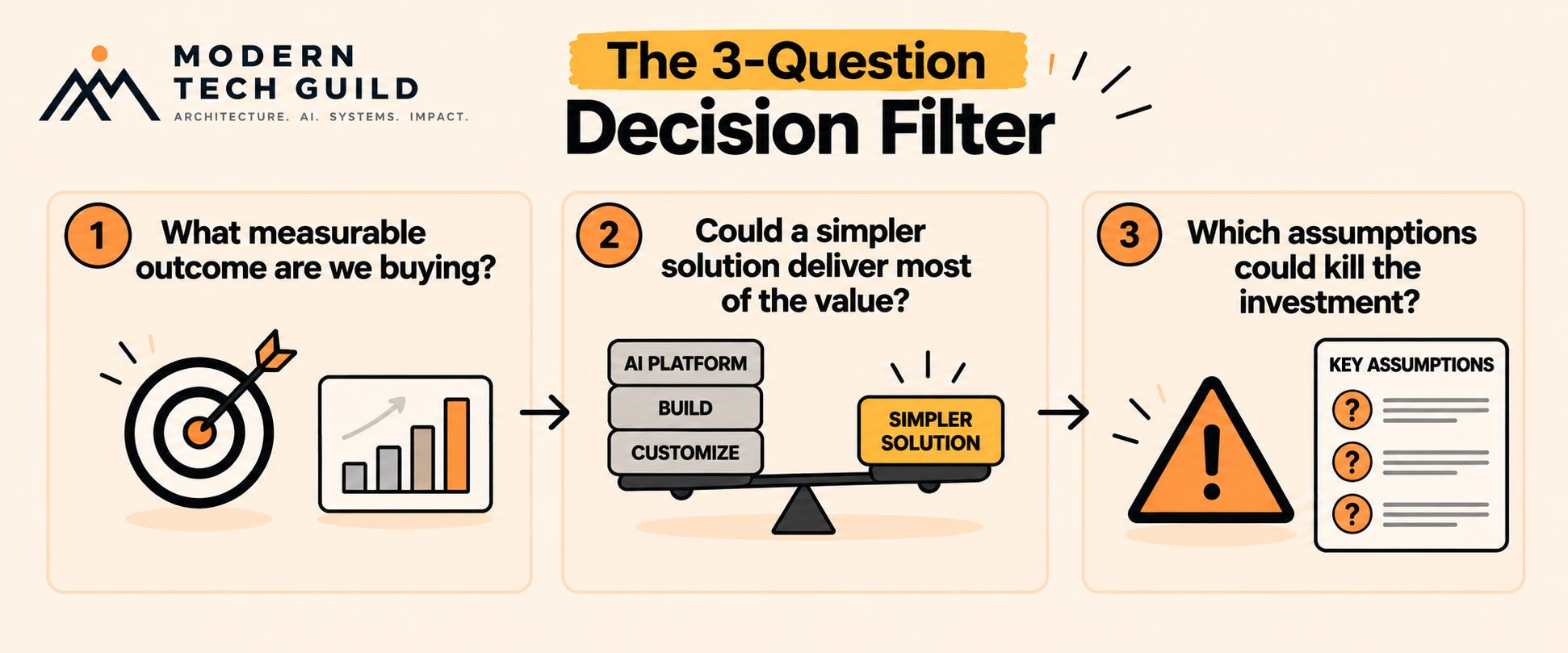
Now, let's put this filter to work on our $1.2 million AI proposal.
Q1. What measurable outcome are we buying?
Start with the economics, not the demo.
Suppose your support operation handles 100,000 tickets annually at an average cost of $15 per ticket.
That’s $1.5 million in annual support costs.
The vendor claims it can automate 60% of those tickets.
Sounds promising.
But what does automate actually mean?
Does the AI resolve the ticket without human intervention?
Or does it draft a response that an agent still needs to review?
And are those 60,000 tickets genuinely suitable for automation?
Let’s assume the vendor’s claim holds: 60,000 tickets are fully resolved by AI annually, and each avoids $10 in existing support costs.
That’s $600,000 in annual gross savings.
Now look at the three-year investment.
Financial assumptionAmountAnnual ticket volume100,000Tickets automated annually60,000Avoided support cost per ticket$10Annual gross savings$600,000Three-year gross savings$1,800,000Three-year vendor contract$1,200,000Remaining benefit before other costs$600,000
At first glance, the investment appears attractive.
But that remaining $600,000 isn’t profit.
It must still cover implementation, integration, internal operations, human oversight, and any additional AI usage costs excluded from the vendor contract.
And there’s another assumption hiding in the numbers.
The calculation assumes the full 60% automation rate from day one.
What if the first year achieves only 20%, the second 40%, and the third 60%?
At the same $10 avoided cost per ticket:
Year 1: $200,000 saved
Year 2: $400,000 saved
Year 3: $600,000 saved
That’s $1.2 million in gross savings over three years—exactly equal to the vendor contract.
Before paying for integration, implementation, or ongoing oversight.
Suddenly, the economics look very different.
Your move: Ask for the current ticket volume, realistically avoidable cost per ticket, expected automation ramp-up, and fully loaded three-year investment cost.
Decision rule: If the business case only works under the vendor’s most optimistic assumptions, don’t recommend approval. Validate those assumptions first.
Q2. Could a simpler solution deliver most of the value?
Before evaluating the agentic platform, compare three alternatives.
OptionWhat to testImprove existing workflowsCan rules-based automation handle order-status requests and standard refunds?Extend current platformsCan existing support tools and AI features resolve common queries?Buy the agentic platformDoes autonomous execution justify the additional cost, complexity, and risk?
Consider the refund example.
If eligibility follows deterministic business rules, do you really need an autonomous agent to decide?
Perhaps a workflow engine can handle standard refunds, while an AI assistant helps classify unusual requests.
That might solve much of the problem without introducing autonomous financial transactions.
Compare all three options against expected business value, three-year total cost, delivery risk, and time to value.
Complexity is a cost. It needs to earn its place.
Your move: Build a one-page comparison using the same criteria for every option.
Decision rule: Recommend the least complex option that meets the required business outcomes and risk constraints.
3. Which assumptions could kill the investment?
Every architecture decision rests on assumptions.
The dangerous ones are the assumptions nobody has tested.
For this AI platform, I’d start with three.
01 — DATA RELIABILITY
Assumption: Our customer data is accurate enough for AI-driven decisions.
Validation: Audit 100 representative support tickets across order systems. Check for missing fields, inconsistent records, and incorrect order statuses.
02 — AI SAFETY & ACCURACY
Assumption: The AI can resolve customer requests without creating unacceptable business risks.
Validation: Test 200 historical cases, including refund exceptions, delivery disputes, and unusual customer requests. Measure correct resolutions and critical failures separately.
03 — INTEGRATION FEASIBILITY
Assumption: The AI can safely execute transactions across existing enterprise systems.
Validation: Prove one end-to-end refund workflow, including authorization, business-rule enforcement, error handling, and audit logging.
Define acceptance criteria before running these tests.
For example, an agent might resolve 90% of test requests correctly.
Impressive?
Not if the remaining 10% includes unauthorized refunds, privacy violations, or incorrect customer updates.
Average accuracy can hide unacceptable failure modes.
Your move: Identify the three assumptions most likely to invalidate the business case and design a test for each.
Decision rule: If a critical assumption fails, recommend redesigning, reducing scope, or stopping. Don’t defer it to implementation.
Turn the Evaluation Into a 10-Day Decision Sprint
You don’t need to turn every vendor proposal into a six-month architecture exercise.
Start with a focused assessment.

Days 1–2: Establish the business case.
Validate ticket volumes, current costs, automation eligibility, and expected financial benefits.
Days 3–4: Compare alternatives.
Evaluate workflow automation, existing platform capabilities, and the proposed agentic solution. Estimate three-year costs and major trade-offs.
Days 5–8: Test critical assumptions.
Use representative support tickets to test data quality, AI reliability, and one controlled integration workflow.
Days 9–10: Make the recommendation.
Produce a one-page decision record containing the evidence, unresolved risks, and next approval gate.
Ten days won’t establish production readiness. And the schedule assumes access to the necessary people, data, and test environments.
But it can tell you whether the proposal deserves further investment.
Your recommendation should lead to one of three outcomes:
Proceed to the next approval gate: Evidence supports further investment, subject to required approvals.
Pilot: The opportunity is promising, but material uncertainty remains. Recommend a limited experiment with explicit success criteria.
Stop or redirect: The expected value doesn’t justify the cost or risk.

So What Do You Tell the CEO?
The next time you are put on the spot, drop the technical defensive stance. Speak the language of capital allocation.
Try using this exact script:
“The opportunity is interesting, but I wouldn’t recommend committing $1.2 million based solely on a polished vendor demo.
The vendor claims a 60% automation rate. Before we accept that risk, I want to run a 10-day decision sprint. We will validate which ticket types are actually suitable, compare simpler rules-based alternatives, and run a controlled test to see how their AI handles our messy production data.
By next Friday, I’ll hand you a one-page decision record showing exactly whether this investment will return its capital, or if a simpler internal workflow can give us 80% of the value for a fraction of the cost. Let’s protect the capital first.”
No endless architecture debates. No giving in to vendor hype. Just evidence, trade-offs, and clear technology judgment.
Closing the Ambiguity Gap
Executing a 10-day decision sprint sounds straightforward, but building architectural comparison frameworks, data auditing parameters, and one-page executive decision memos from scratch every time takes hours of unbillable mental strain.
That is why I am building The Tech Leader’s Decision Vault.
It is a centralized, plug-and-play repository containing pre-formatted Architecture Decision Records (ADRs), Vendor Hype-Auditing Matrixes, and the exact One-Page Executive Canvas used to align C-suite stakeholders without the cognitive load.
We are dropping it soon. If you want to build ironclad technology judgment and stop defending your architectural boundaries with emotion, make sure you are on the list.
If you’re finding this newsletter valuable, consider sharing it with friends, or subscribing if you haven’t already.
I’d add another consideration: competitive blind spots.
The CEO you’re pitching is often playing 3D chess. He or she is thinking about competitors, customer expectations, and where the business needs to be in the next quarters and years (plus they have a fiduciary duty to think this way).
They’re weighing both “What happens if we buy this and it fails?” and “What happens if we dismiss it and our competitors figure it out?” Or “do we have the in-house talent to build it?”
That doesn’t justify buying into every AI pitch. But a good evaluation should challenge the blind spots in both the vendor’s promises and the company’s own assumptions.